
The Tradwife Fantasy Is a Lie (and the Patriarchy Is Cashing In)
Those “tradwife” influencers you see floating across your feed in pastel aprons, designer dresses, and flawless curls? They’re not living the fantasy they’re selling — they’re cashing in on it, while you’re left comparing yourself to a performance built to make you feel small and inadequate.
Do you really think a woman who bakes her children’s fucking cereal from scratch, homeschools five kids under eight, keeps a spotless house, and exists solely for her husband’s happiness also has the time and energy to film an endless stream of content for millions to consume? The tradwife aesthetic is a business model, not a belief system. It’s curated, filtered patriarchy: soft enough to look appealing, but still designed to keep women small and in check.
They’ve found a lucrative niche selling submission as self-care, turning the fantasy of the 1950s housewife into something you can buy, share, and aspire to. It’s the perfect grift for a system that still depends on women doing unpaid labor and calling it love. By the way, labor that, if actually compensated, would be worth an estimated $10.9 trillion globally every year.
What Even Is a “Tradwife”?
The term “tradwife” comes from “Traditional Wife,” a woman who embraces old-fashioned gender roles where men earn the money and women serve the home. It’s marketed as wholesome, feminine, and God-approved — once again weaponizing religion to lift men and smother women.
But here’s the truth: this wasn’t tradition. It was exclusion.
In the United States, the romanticized stay-at-home housewife of the 1950s only ever applied to a narrow slice of society—mostly white, middle-class women whose husbands earned enough to sustain a one-income household. Working-class women, women of color, and immigrant women have always worked. They were cleaning other people’s houses, nursing other people’s children, and holding entire industries together while white suburbia played house.
The “traditional” gender roles being sold online are a myth, and a dangerous one. They erase history, glorify inequality, and rebrand submission as empowerment. Because what’s really being sold isn’t homemaking—it’s obedience. Aesthetic obedience. Marketable obedience. The kind that looks good on camera and keeps the patriarchy profitable.
Why It’s Harmful: The Patriarchal Bait and Switch
Let’s be honest—the tradwife fantasy is seductive. Who wouldn’t want a life that promises safety, softness, and simplicity? No hustle, no burnout, no bills you can’t pay. But that fantasy only exists because someone else is paying the price for it: you.
Tradwife culture tells women their highest purpose is to serve their husbands, their homes, and their children. It tells them to find fulfillment in dependence, to mistake obedience for peace. It’s a soft-focus commercial for self-erasure, selling the idea that love means surrendering your autonomy, your income, and your safety net.
Dependence isn’t devotion—it’s a liability. When you rely entirely on a partner for survival, you don’t have freedom, you have permission. And what then? You get an allowance? Like a child too young to work?
What happens when the marriage falls apart—when addiction, illness, or abuse enters the picture? When he dies—or simply decides to leave? Most women in those situations don’t have the ability to just walk away; they have to start over from nothing. Financial dependence doesn’t protect you, rather it traps you. It keeps you tied to a life you might otherwise escape.
Today in the U.S., there are about 11.6 million widowed women and roughly 1.2 million adults lose a spouse each year. (Securian Financial)
And when abuse is involved, the numbers are even starker: financial abuse occurs in 99% of domestic violence cases (i.e. control over finances is nearly universal in abusive relationships) (NNEDV)
And survivors of intimate partner violence lose about 8 million days of paid work every year in the U.S. because of the abuse. (Center for Domestic Peace)
That’s not empowerment—it’s economic vulnerability disguised as “traditional values.” Even if the relationship survives, being financially powerless is an invisible leash. If he controls the money, he controls the choices—the vacations, the groceries, the house, the healthcare, the life.
And the tradwife dream doesn’t just trap women; it breaks men, too. They’re told that “real masculinity” means carrying the full financial load, being the protector, the provider, the one who never falters. No wonder so many buckle under that weight. It’s a toxic performance on both sides—a home built on imbalance and resentment, where no one truly thrives. This isn’t tradition, it’s regression. And the only people winning are the influencers cashing in on your clicks and views.
♡ This blog is free for everyone and supported by readers like you.
If you want to help keep it going, you can join the Full Blog or make a one-time contribution. ♡
The Alt-Right Connection
It would be a mistake to think the tradwife trend is just an aesthetic or a quirky online subculture. Behind the lace aprons, the gorgeous farmers market hauls, and the homemade bubblegum lies something far more strategic. The rise of the tradwife ideal is entangled with the alt-right movement, white nationalism, and patriarchal politics. And before you rush to defend your favorite tradwife creators, don’t infantilize them. They know exactly what they’re doing.
Tradwife influencers often echo extremist talking points about “saving Western civilization,” “protecting the nuclear family,” and “restoring natural order.” It’s a softer, prettier entry point into reactionary ideology. By presenting submission as wholesome and politically neutral, it becomes easier to smuggle in messages about gender, race, and power that align with far-right values.
It’s also important to recognize that the tradwife fantasy is built around whiteness. The imagery of neutral kitchens, prairie dresses, and “timeless” femininity comes straight from a nostalgic vision of midcentury America—one that never included everyone. That version of “tradition” erased the labor of women of color, immigrant women, and working-class women who sustained families and communities while being excluded from that ideal. Even now, the tradwife aesthetic rewards proximity to whiteness: its beauty standards, its moral language, and its domestic imagery all position white, middle-class femininity as the most desirable and “natural” form of womanhood.
And let’s not forget our social media overlords, throwing this shit in our faces every day. Online, this content is algorithmically rewarded. Platforms amplify what feels comforting, nostalgic, and safe. The serene neutral kitchens and perfect families make the underlying messages seem harmless, even aspirational. But once you peel back the branding, you see how the narrative feeds into a much darker worldview—one where women’s worth is defined by their service, and anyone who resists that role is portrayed as broken or unnatural.
The alt-right doesn’t need women to march in the streets waving flags. It just needs them to romanticize their own subjugation. The tradwife movement does exactly that, turning regression into lifestyle content and selling it as empowerment.
The Illusion of Empowerment
To understand why the tradwife trend has gained traction, we have to admit something uncomfortable: modern life is exhausting. Late-stage capitalism has left many people—especially women—burned out, overworked, and underpaid. The fantasy of a slower life, of being cared for and protected, hits a nerve. It feels so gentle, like a warm hug: the idea that someone could take care of us while we nurture others and ourselves. It’s a beautiful fucking fantasy, but it’s just that.
There’s nothing wrong with wanting rest, softness, or stability. Those desires are deeply human. The problem is that the tradwife ideology takes those valid needs and sells submission as the solution. It offers women relief from the grind, but only if they give up their autonomy.
In this way, tradwife culture functions as emotional bait. It tells women that liberation has failed them, that empowerment is just stress in a nice pant suit, and that true feminine fulfillment can only be found by returning to “natural” gender roles. It’s a comforting story because it offers an escape. But it’s an escape into dependency, not freedom.
Here’s the irony: most of the women promoting this lifestyle aren’t living it. They’re entrepreneurs, influencers, and content creators whose income often far exceeds that of the men they claim to depend on. They use algorithms, branding, and partnerships—tools of the very system they pretend to reject—to profit from the independence they tell other women to give up.
If they were truly living by the values they preach, they wouldn’t be online at all. Their husbands would own their platforms, control their income, and decide whether they could post. That’s the real “traditional” model—and it’s not cute, romantic, or empowering. The tradwife fantasy doesn’t empower women. It just disguises old-fashioned subjugation in better lighting.
The Reality Check (and Reclaiming Power)
The tradwife fantasy might look comforting, but it’s built on control. The reality is that most families in the United States today cannot survive on a single income.
In fact, only about 7 percent of U.S. households fit the traditional model of a married couple with children and only the husband working (Population Reference Bureau).
Dual-income households now far outnumber single-earner families, largely because the cost of living has outpaced wage growth (Bureau of Labor Statistics).
Even if a single income could sustain a family, tying your survival to someone else’s paycheck is a risk no one should be pressured to take.
Financial independence is not a rejection of love or family. It’s the foundation that makes love and family safer. It means you can make choices based on mutual respect, not financial necessity. It means you stay because you want to, not because you have no other option.
Tradwife ideology also hurts men, despite pretending to uplift them. When men are told that their worth lies only in providing, it disconnects them from their emotions, their partners, and their children.
Research shows that men who conform most strongly to traditional masculine norms—like emotional suppression and the “provider” identity—are more likely to experience depression, stress, and relationship strain (American Counseling Association).
The bottom line is that everyone loses in a system built on inequality.
The truth is that liberation, not submission, is what gives us room to rest, create, and connect. Freedom and softness are not opposites; they coexist. You can choose nurturing, homemaking, or motherhood if that’s what fulfills you—but it should be a choice, not a performance demanded by tradition or ideology.
The tradwife movement tries to sell obedience as empowerment. But empowerment doesn’t come from recreating a fantasy that never existed. It comes from building a life where you are free to decide what’s right for you, without apology.
We don’t need to go backward to find peace. We need a world that values women’s autonomy as much as their care, that honors interdependence without erasing individuality.
The past the tradwives are selling was never real. But your freedom is.
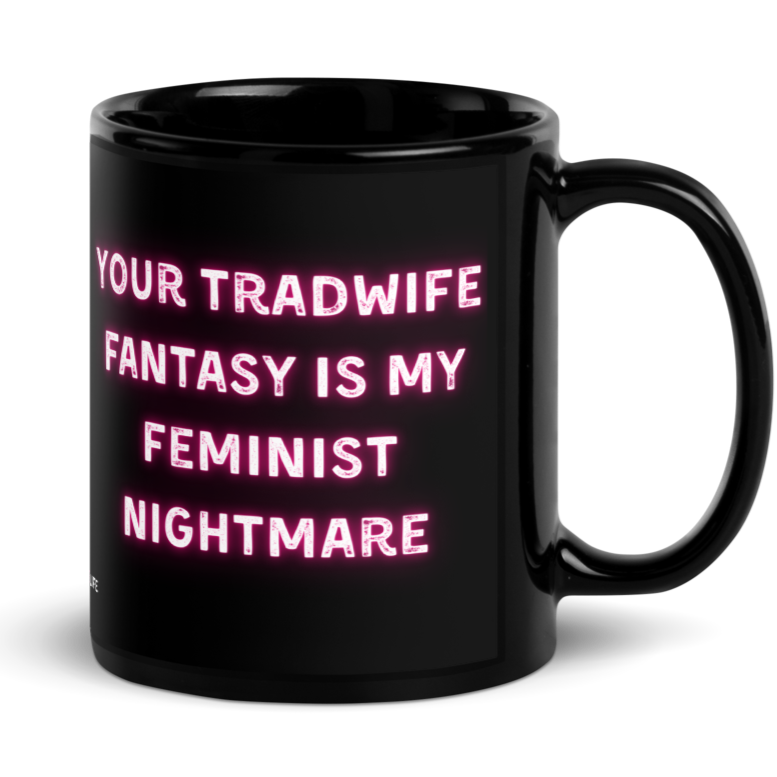
(If you’re nodding along right now, you’ll probably love the Her Childfree Life mug that says it all: “Your tradwife fantasy is my feminist nightmare.”)
Author’s Note:
At Her Childfree Life, we challenge the stories women are told about what fulfillment should look like. Whether that story comes wrapped in baby pink or domestic bliss, the message is the same: shrink yourself, be grateful, and call it love.
You deserve more than nostalgia disguised as purpose. You deserve to define your own version of peace, power, and partnership—on your own terms.
Additional Recommended Reading:
Her Childfree Life exists because of readers who support the work through The Full Blog — where I share early releases, longer essays, and members-only reflections.
Support independent feminist writing and gain full access to every essay, reflection, and commentary on Her Childfree Life. Your subscription helps keep this space ad-free, community-driven, and open for meaningful member discussions.